

A Cycle of Crisis and Resolution
A familiar move from the patriarchal playbook returns — again and again.

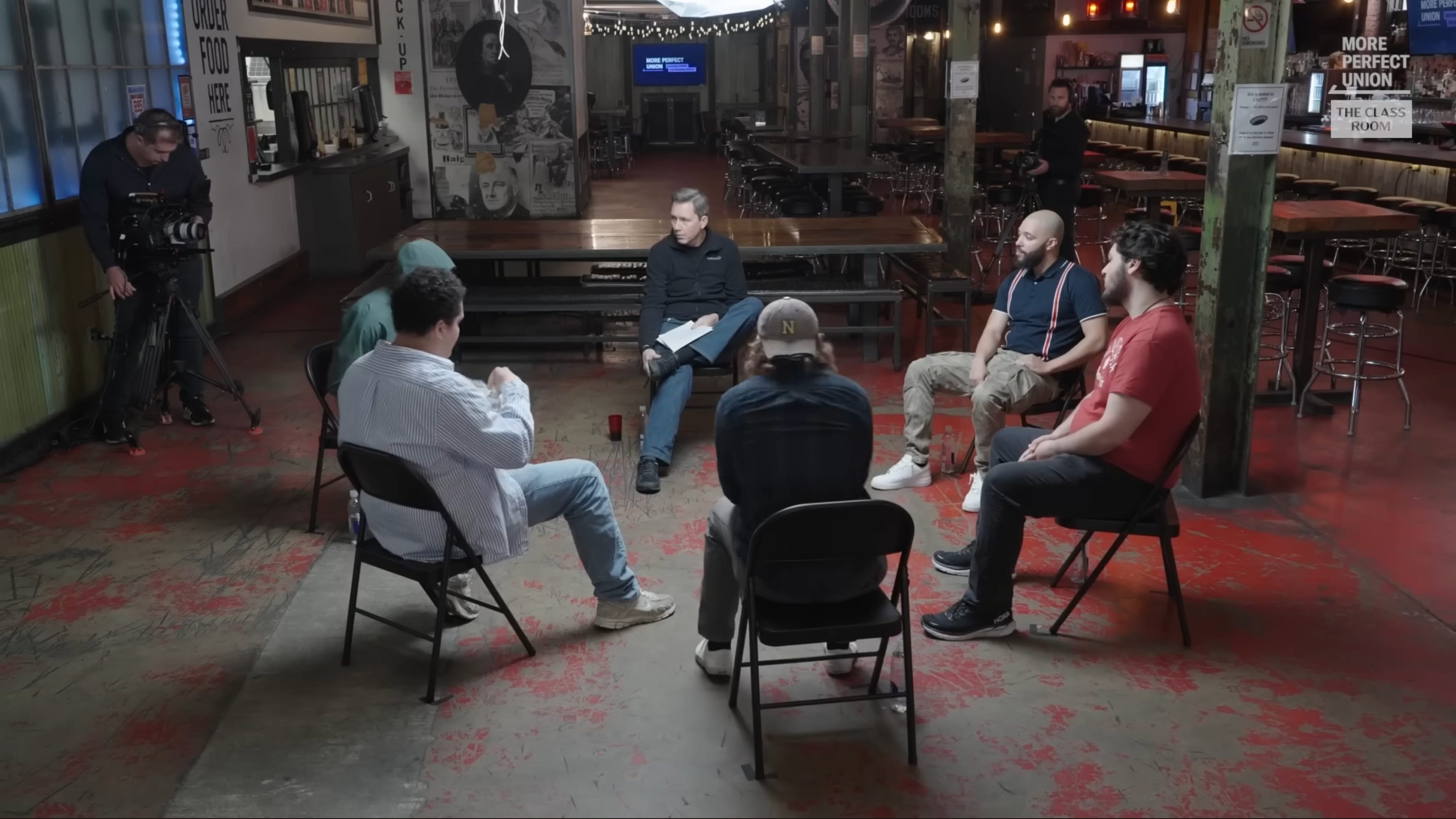
On a recent night of Instagram doom-scrolling I paused on a video titled “What Men Think,” which promised to explain why the $20 million the Democrats have spent to “figure out men” since the election of Donald Trump has largely been wasted (its title on YouTube is “Why Young Men Don’t Like The Democrats”). Produced by More Perfect Union (@perfectunion on IG), it begins with a group of young men sitting in a circle talking to each other about things like the appeal of Donald Trump, the politicization of masculinity, and the need for greater class consciousness in politics.
Then the host appears, Richard V. Reeves, who is a Senior Fellow at the Brookings Institution and President of something called the American Institute for Boys and Men. Reeves asserts that people are suddenly talking about young men more than ever but that this conversation needs some guidance. Reeves, who wrote the 2022 book Of Boys and Men: Why the Modern Male Is Struggling, Why It Matters, and What to Do About It (a 2024 Barack Obama Summer Reading Selection) clearly positions himself and his research as providing that needed focus.
Seeing him here is what piqued my interest. First, because More Perfect Union was founded in 2021 by Faiz Shakir, a senior advisor to Bernie Sanders, as a non-profit newsroom that seeks to “build power for working people.” It has now amassed over 850,000 followers on IG and 1.75 million followers on YouTube, partially via their series “The Class Room,” which won the Hillman Prize for Opinion and Analysis in 2023 and has been described by The New York Times as being “aimed at providing a left-wing answer to PragerU, a YouTube titan of right-wing ideology.” On their About page they proclaim “we seek to hold accountable the ultra-rich” and that they do not take money from corporations. So Reeves, and by association the Brookings Institution, might feel like an imperfect spokesperson for the channel.
Reeves has historically advocated for "radical centrism" (having once been the strategy director for Nick Clegg, the then Leader of the Liberal Democrats in the UK) and Brookings is a think tank partially funded by the likes of Google and Meta (the latter of which currently employs that same Nick Clegg as their President of Global Affairs). In 2022, he wrote a piece for Bari Weiss’ The Free Press titled “The Boys Feminism Left Behind” in which he advocates for “less discussion of patriarchy and more practical solutions” to help steer young men away from far right populism.
This later piece is helpful in explaining how he ended up on More Perfect Union’s IG feed in 2025 next to videos advocating for Philadelphia’s striking city workers. Reeves is among the prominent voices on the so-called left who are campaigning to convince millions of Americans that Donald Trump is our president again because of a failure to focus on the issues facing young men. In the video, Reeves claims that the attention on this group is higher than at any time since he started his research, but in truth his talking points have been prevalent across mainstream media for decades — if not much longer.
In 2018, I wrote a review of Thomas Page McBee’s memoir, Amateur: A True Story About What Makes a Man. In it I compared McBee’s story of transitioning while training to become an amateur boxer to the work of Jordan Peterson, whose 12 Rules of Life was selling millions of copies worldwide and was at the time described by The New York Times as one of the most foremost “public intellectuals in the English-speaking world.” Here’s an excerpt from that review:
McBee’s deconstruction in Amateur…is likely the destabilizing sort of rebellion that Peterson is afraid of. What connects these two, though, is an agreement that we’re amidst a historic turning point for men in the West. And they’re not alone in that assessment. While Peterson finds reason for concern in the lack of masculine structure in the world, McBee pinpoints a rising tide of frustrated white men in the years leading up to the election of Donald Trump. “Men keep trying to fight me,” he tells friends. Sociologist Michael Kimmel, who appears in Amateur, wrote his own treatise on “angry white men” in 2013, and the frustrations he documented—which today have led many to Peterson—seemed to come to a head during that year’s #GamerGate harassment campaign (The Guardian described Gamergate as a “last grasp at cultural dominance.”)
Yet nearly 15 years earlier, in 1999, author Susan Faludi observed that in the face of social upheaval and a changing economic landscape, “the elements of the old formula for attaining manhood” had “vanished,” and men were increasingly sad and angry as a result. It seemed to her, at the time, that men had “lost their compass in the world.” And 40 years before Faludi wrote Stiffed: The Betrayal of the American Man, Arthur Schlesinger Jr. wrote a 1958 essay for Esquire titled “The Crisis in American Masculinity,” in which he echoes Peterson’s fear of change, declaring that something has “gone badly wrong with the American male’s conception of himself.”
The examples stretch back much further (Kimmel has a piece titled “The ‘Crisis’ of Masculinity in 17th-Century England”) and point to something more systemic. The racist aggression in Charlottesville was not only a defense of this country’s ever-present history of white supremacy but of white supremacist patriarchy. Indeed, as Tania Modleski once wrote, men have historically consolidated their power “through cycles of crisis and resolution…”
These historical moments of “crisis,” like today’s, can always be mapped on a timeline next to movements for social change related to race, gender, sexuality, and class. It’s not hard to imagine why a white man in 1958 America, amidst the civil rights movement, might be worried that his definition of masculinity was under threat. Or why in 17th century England — as capitalism spread, people moved from farms to cities, and women started asking for more out of marriage — there was a growing fear that men were losing an aspect of masculinity, becoming “feminized,” and abandoning traditional relationships (a satirical poem written by John Evelyn in 1691, captures some of these fears: “the world is chang'd I know not how; For men Kiss Men, not Women now.”)
So the cycle continues in 2025. In the video for More Perfect Union, the young men and Reeves discuss a loss of jobs related to technology, changing industry, and lack of education amongst men. They reflect on an increasing cost of living that makes it impossible to meet a still implied standard of masculinity related to “providing.” And Reeves says “both sides” are failing these men, with the Democrats refusing to adequately acknowledge the difficulties facing the group and the Republicans solving for this by turning back the clock to an outdated social “script.”
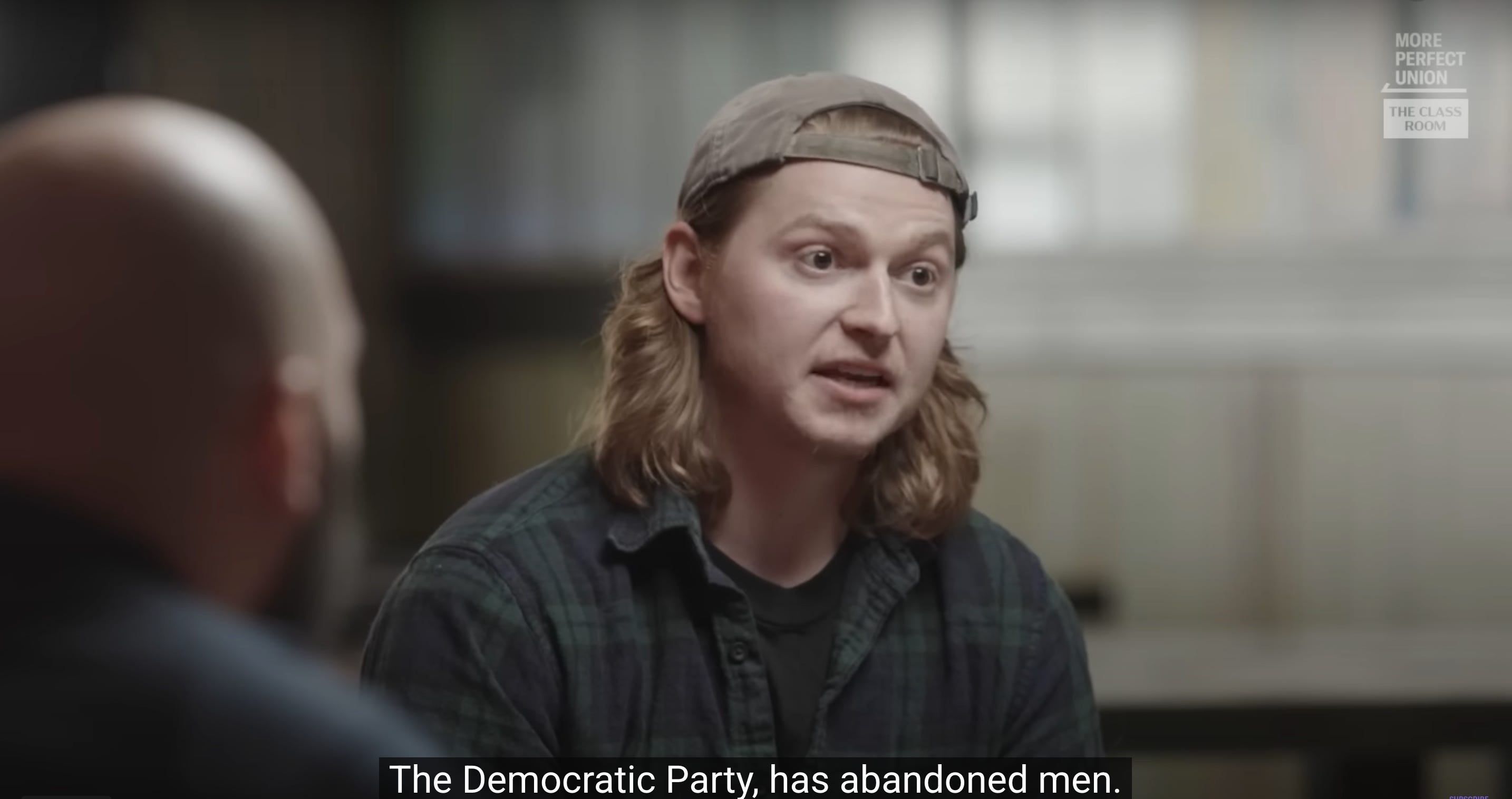
Yet as much as the men claim they aren’t interested in returning to the past, the video seems to suggest an alignment around the idea that men should be allowed to “just be men.” Reeves has said in the past that he doesn’t believe that women’s apparent gains are the reason for men’s losses, but he also argues here that an over-focus on “toxic masculinity” from the “women’s party” has pushed men to the right looking for community and comfort. This discussion pins much of this moment’s crisis on a framing of masculinity — the implication being that it was popularized by feminists — which the interviewed group sees as vague, unnecessary, and an attack on individual qualities over systemic problems. The final statistic on screen compares a closing gender pay gap with an increasing class pay gap, as if to say an overemphasis on gender may have led to a loss for all working people.
If you blink you might miss the familiar tactics being employed here to emphasize crisis and consolidate power.
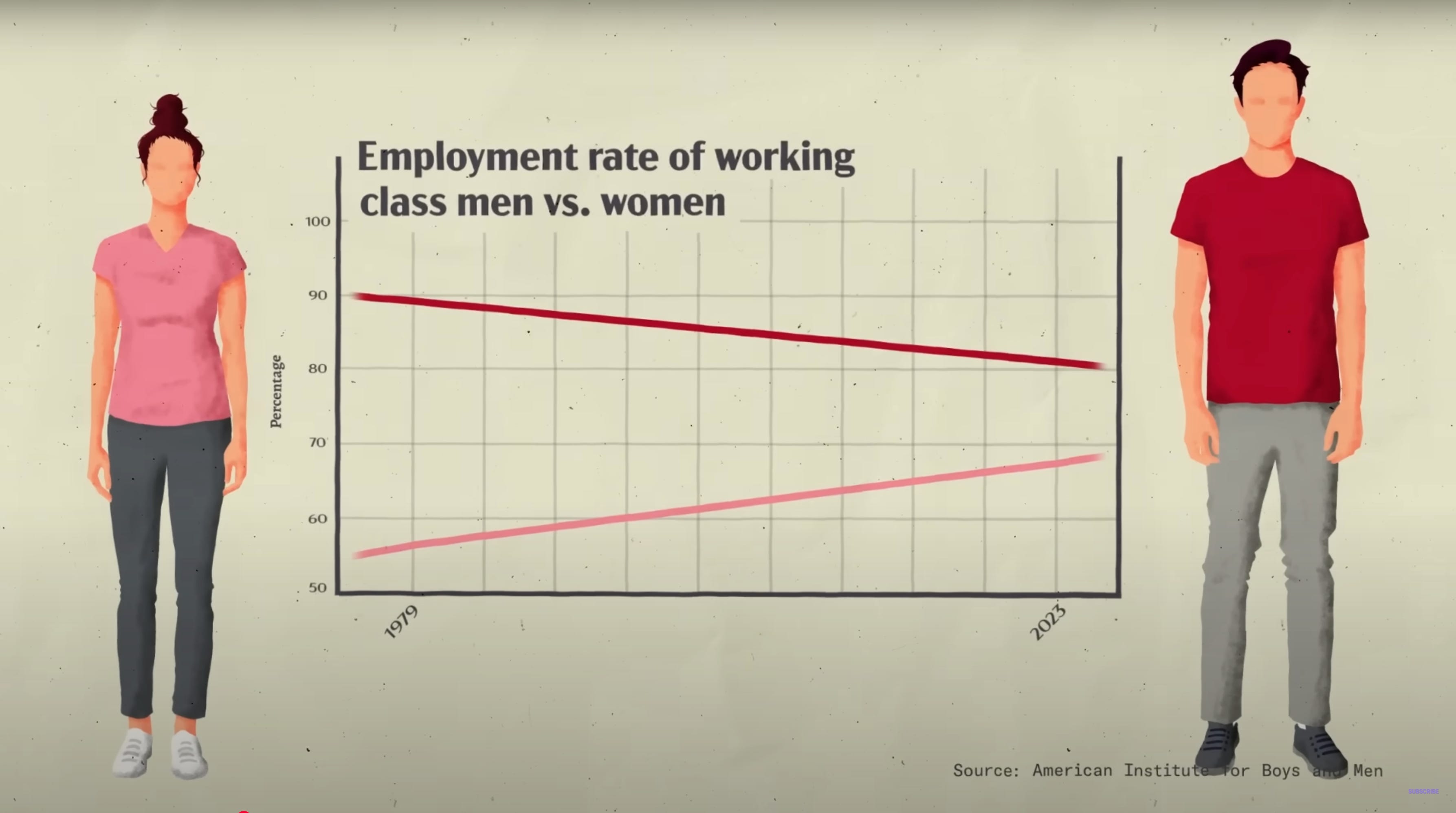
One is to use “working class” largely as a pseudonym for the labor men do, without really mentioning the labor women and people of other genders do (at one point one of the participants reflects that his grandmother “never” worked, but Reeves does not bring up the unpaid labor his grandmother was surely doing in the home). One chart early on, from Reeves’ own organization, shows that the employment rate for working class men has gone down as the rate for women has increased since 1979 — yet it very clearly shows that women have still not surpassed men (and does not chart people of other genders).
Women are still paid less than men overall according to Pew, and are less likely to hold positions of leadership. And while men may feel the pressure to provide, that same study found that two-thirds of “working mothers” with kids under 18 feel pressure to focus on responsibilities at home, compared to 45% of “working dads.” This gap is slightly greater than the gap the study found in terms of the pressure married men feel to support a family compared to women (60% vs. 43%, though the numbers actually nearly even out if you include unmarried parents, as there are so many more women in that category).
Meanwhile, if we’re talking about the pressure to get an education, it’s worth noting that according to Third Way, “median earnings for non-college women are…30% lower than non-college men,” and “there are two times as many Black women of working-age without degrees than with one.” Plus, “non-college women are five times more likely to be out of work for caregiving reasons than non-college men.”
So at the very least, this so-called “crisis” needs greater context and more intersectional analysis.
Reeves also wants to portray his interventions as novel, but the popularity of his book was helped by a recommendation from Obama, who as President in 2014 started his own organization focused on the issues of Black boys and young men called My Brothers Keeper (which I’ve written about previously here). Reeves solutions — such as encouraging men to seek therapy and to take jobs in healthcare and other industries that have been historically gendered for women — are also ideas that have been written about by feminists of color for decades. What Reeves is doing is presenting familiar solutions in a way that is intentionally less threatening to men.
None of this means we should ignore the reports that find increasing loneliness amongst working class men or higher rates of suicide. But Reeves, like Jordan Peterson, attempts to tie these outcomes to talk of “toxic masculinity” and the left’s broad rejection of men. Yet the difficulty he and the group he assembles have in defining the phrase — or where he locates a crisis — could just as easily lead to another question: what is masculinity itself? What is a man, and how might the borders of this category be related to these struggles?
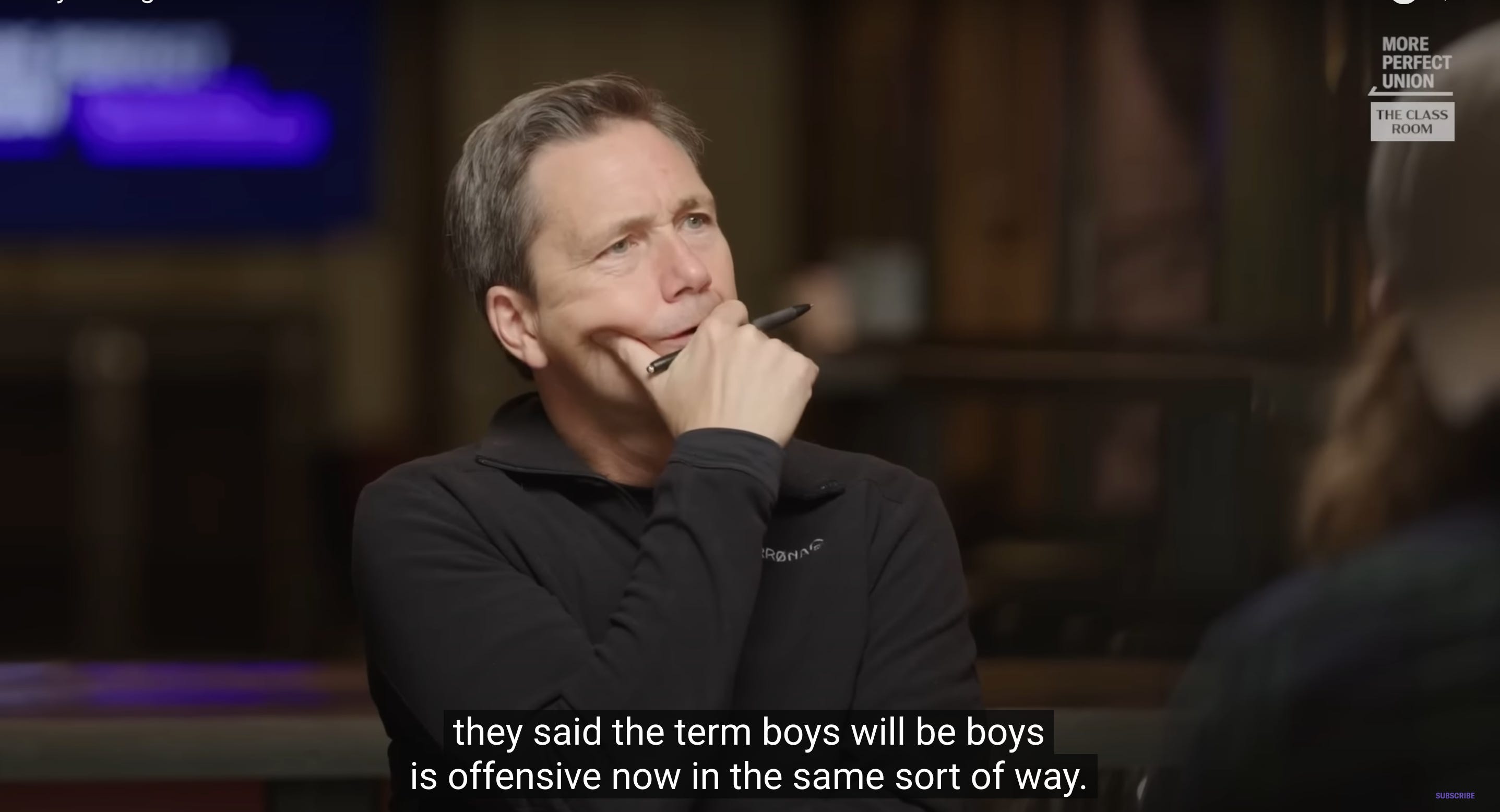
The concept of “toxic masculinity” is indeed unhelpful, but only because it implies that there is another form of masculinity that could be different — without addressing the fundamental role of the idea within patriarchy. Reeves says we should be concerned with systemic issues, but this necessarily includes discussing a society structured around a gender binary and, within that, the dominant position of men.
Though in this video he portrays himself as a pragmatist just looking for a solution, in his 2022 essay for Bari Weiss he says more of the quiet part out loud. There, in his list of requests of feminists, he includes “recognizing that there are some differences between males and females that are not just socially determined, but biologically based.” He goes on to write, “Feminism has succeeded without destroying the idea that there are inherent female traits. The same courtesy should be extended to males.”
I think this is at the crux of the current discussion about young men and why we find ourselves in this loop repeatedly. What Reeves gets to obscure by positioning himself as the salve for the hurt of working class men, is that the insistence on inherent “male” and “female” traits ultimately benefits men like him most of all. Contrary to what he says, feminism has not succeeded if people are out here still believing that there are “inherent female traits.” Nor has patriarchy been “effectively demolished in advanced economies” while straight cisgender white men still clearly dominate us all.
Reeves ends the video by saying we need a new script for men that is compatible with “gender equality.” But in a system of imperialist white supremacist capitalist patriarchy, maintaining belief in the gender binary is itself also maintaining a gender hierarchy — where certain men are always on top. Any script written with that belief will never end with our liberation. The real crisis then is that so many still cling to this narrow conception of gender. We have to be willing to ask more of men, not less, and more of each other too. And that includes leaving the idea of masculinity behind completely.
To be continued…